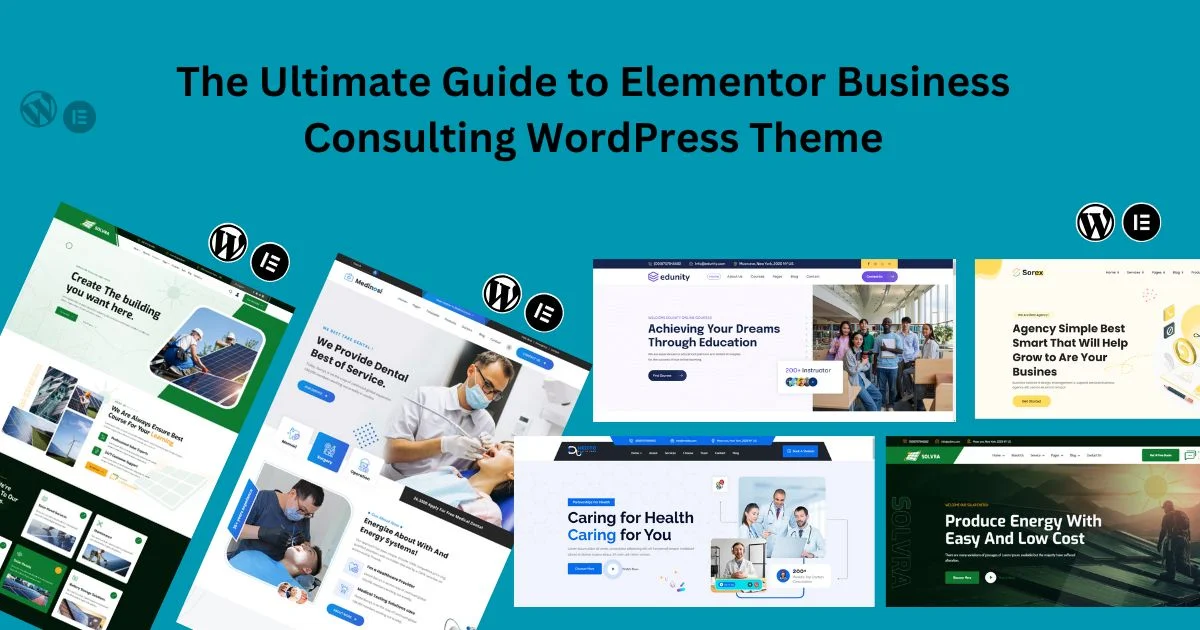
A consulting website template is the fastest way to launch a professional site for a consultant or advisory firm, and with WordPress and Elementor you can edit every page yourself without code. This guide walks through the full process step by step: choosing the right format, installing a theme, importing a demo, building the key pages in Elementor and checking the site before launch. It is written for solo consultants and small firms, and we point out the steps people most often skip.
| Format | Who edits it | Strengths | Trade-off |
|---|---|---|---|
| WordPress theme + Elementor | Owner or assistant | Visual editor, blog, plugins | Needs updates and backups |
| HTML template | Developer | Fast static pages, simple hosting | Every edit is a code edit |
| Figma or Adobe XD file | Designer, then developer | Approve the look before building | Not a working website |
There are three common starting points, and the right one depends on who will edit the site after launch.
If you are unsure, choose a WordPress theme with Elementor. You can change text, images and layouts in a visual editor, publish articles from the dashboard and add features such as booking forms with plugins.
Writing the copy first saves time, because you will choose layouts that fit your content instead of squeezing content into a demo.
Install WordPress from your host’s control panel. Go to Appearance, then Themes, then Add New, and upload the theme zip file you downloaded, or install a free theme from the WordPress.org directory. Activate it. Most premium themes then ask you to install required plugins, such as Elementor and the theme’s own core plugin. Install only what the theme lists as required.
Use the theme’s one-click demo import to load a complete sample site, including pages, menus and widgets. Import on a fresh install, because demo content can overwrite existing pages. Choose the demo closest to your structure rather than the prettiest one: a demo with service pages, case studies and a booking section will need less work than a portfolio-style layout.
Before you edit individual pages, open Elementor’s Site Settings and set your global colours, fonts, button styles and logo. Changing these once updates every page that uses them. Keep to two fonts and a small palette, and check that text has enough contrast against backgrounds for readability.
Open each page with Edit with Elementor and replace demo content with your own.
Delete demo pages you do not need, so search engines do not index placeholder content.
Connect the contact form to your email and send a test message from a phone. If you book discovery calls, embed a calendar tool on the contact page. Add an automatic confirmation email so visitors know their message arrived. Install an SMTP plugin if test emails do not arrive, because many hosts block the default mail function.
OrdainIT builds consulting themes and templates, checks speed and demos before release, and includes free lifetime updates.
For comparisons with other themes, read our guides to the business consulting WordPress theme and our consulting website design guide.
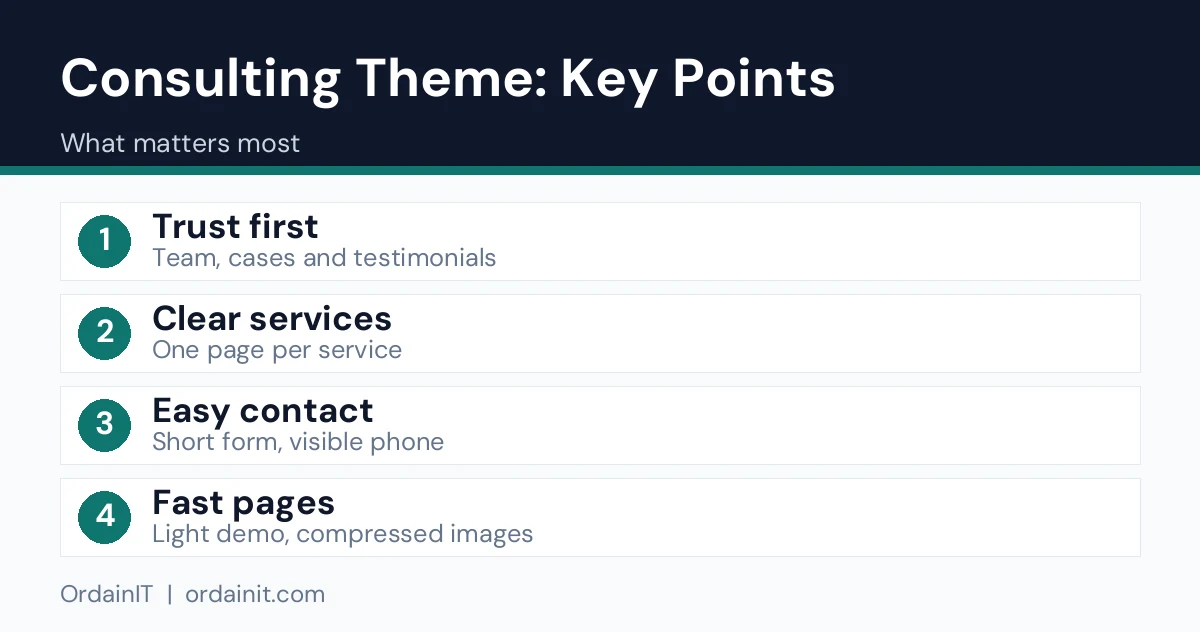
Consulting clients hire people they trust, so the words on a consulting website template matter more than its animations. Start each service page with the client’s problem in their own language, not your job title. Then explain your approach in three or four steps, list what the client receives, and give a typical timeline. Close with one clear next step, such as booking a 30 minute call.
Use numbers where you can: hours saved, costs reduced, revenue gained or projects delivered. If confidentiality stops you naming clients, describe the sector and size of the problem instead. Keep paragraphs short and use headings that a busy reader can scan in seconds.
A site is never finished at launch. Each month, update WordPress, the theme and plugins on a staging copy first, then on the live site after a backup. Publish at least one useful article that answers a question clients ask before hiring you, and link it to the matching service page. Review Search Console for pages with impressions but few clicks, and improve their titles and descriptions. Add new case studies as projects finish, because fresh proof is the strongest sales tool a consulting website template can hold.
Before you open Elementor, sketch the menu on paper: Home, Services, Case Studies, About, Insights and Contact. Six items are enough for most consultants, and a short menu is easier to use on a phone.
It is a ready-made design for a consultant or advisory firm, available as a WordPress theme, an HTML template or a design file, with pages for services, case studies, about and contact.
Not always. Many consulting themes work with the free Elementor plugin. Check the theme’s requirements, because some features such as custom forms or theme builder layouts may need Pro.
With copy and photos ready, a small site with six pages can be built in a few days. Writing the content usually takes longer than the design.
Yes, but pages built with a theme’s own widgets may need rebuilding. Keeping layouts to standard Elementor widgets makes a later switch easier.
A free theme can be enough for a simple site. A premium theme adds more demos, layouts and support, which saves time if you need many pages.
Chosen a theme or template? The OrdainIT team, which designs and builds its own WordPress themes and templates, can also get your website live. Pick a fixed-price service:
Want a design to start from? Browse OrdainIT WordPress themes, each with free installation and lifetime updates, or see all WordPress services. Not sure what you need? Contact OrdainIT for a free, no-obligation quote.
See OrdainIT’s themes and customer ratings on OrdainIT’s ThemeForest profile.